Histories of architecture often operate with concepts of “authorship” and “influence,” centring the figure of the architect and the creative aspects of architectural work. In contrast, this group will explore contemporary approaches to architectural labour as a lens to craft more relational accounts of architectural practice that are perceptive to collaborative and routine aspects of design, as well as the material production and maintenance of buildings. The workshop is interested in reflecting upon the synchronic and diachronic relationships between architectural workers and other co-producers of historical and contemporary built environments — draughtsman, construction workers, engineers, and urban residents. By attending to relationships, in the words of Peggy Deamer, between “intention and execution, thinking and making, opportunity and liability, and innovation and responsibility,” (Deamer 2010) workshop participants will develop more situated portraits of architectural practice based on archival research, oral history, and/or secondary literature analysis.
How might we write histories of architecture and urbanism that account for transience and movement in the construction and maintenance of the built environment? Through collective readings, discussions, invited lectures, and participants’ own writing practice, this interdisciplinary seminar offers a space to explore this question. Together, we will engage with a growing body of scholarship that rethinks modern architectural history—both within and beyond Europe—through the lenses of mobility, mediation, and material flows. These approaches contribute to an expanding historiographical project that decentres permanence and fixity, foregrounding instead the fluid, temporal, and logistical dimensions of the built environment. Rather than focusing on monumentality or singular authorship, we will consider architecture through its mobilities: of technologies, materials, media, and spatial practices in flux.
The seminar is structured around three intersecting scales of “moving architectures.” First, we will explore portable buildings—structures designed to be relocated, disassembled, or reassembled—such as those found in colonial, military, or disaster contexts. Second, we will turn to material entanglements, focusing on the histories of resource flows, and the transient urbanisms that emerge in and around sites of extraction. Third, we will examine foundation structures and technologies for building on unstable terrain, particularly on and with permafrost, considering how architecture interacts with the ground through processes of shifting, stabilizing, and engineering substructures, while also exploring the political and technical histories of rheology. In doing so, we begin to grasp, in the words of Tim Anstey, the “double condition of architecture, as simultaneously a construction of material and of the mediated” (Anstey 2024, 19). The course is open to anyone interested in the history and theory of architecture, spatial politics, or related fields.
Research
Accommodating Extractivism (DFG-funded project)
x
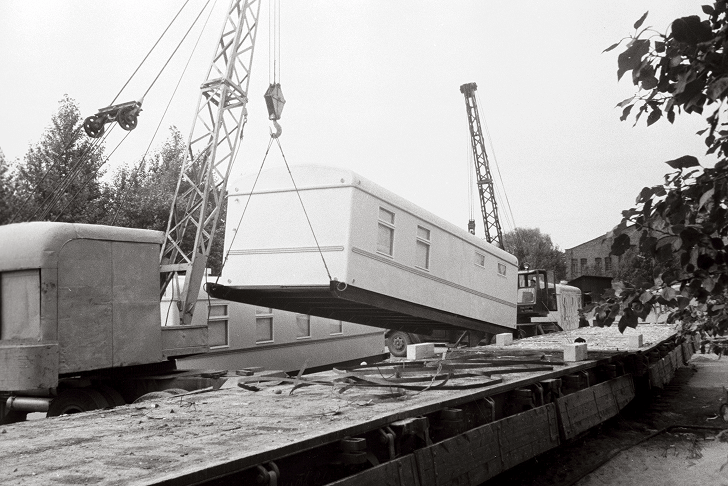
The research project Accommodating Extractivism. Mobile Architecture and Fly-in, Fly-out Urbanism in Western Siberia, 1968–1992 examines the role of architectural expertise and the built environment in transforming Western Siberia into a landscape for fossil fuel extraction during the late Soviet petroleum and natural gas boom. It focuses on archives of Soviet urban planning and design institutes and construction trusts responsible for creating fly-in fly-out settlements and mobile buildings that enabled the mobility of geologists, construction workers, and industry personnel, often on expropriated Indigenous lands. Informed by architectural history and energy humanities, the study reconstructs how design at multiple scales reshaped the Siberian environment and culture into a resource available for extraction.
German Research Foundation (Postdoctoral research)
The project investigates three spatial interventions pivotal to Western Siberia’s transformation into a resource-centred territory: the establishment of a network of permanent cities and fly-in fly-out settlements supporting extractive labour mobility; the production and circulation of mobile dwellings and associated “acclimatisation” theories for incoming settlers; and construction technologies that sought to make resource-driven modernisation scalable in a terrain defined by permafrost soil, swamps, long distances, and “extreme” temperatures. It also examines how these interventions facilitated the displacement of Khanty, Nenets, and other Indigenous groups, marginalised their relationships with the environment, and selectively drew from their material culture to shape imaginaries of portable architecture.
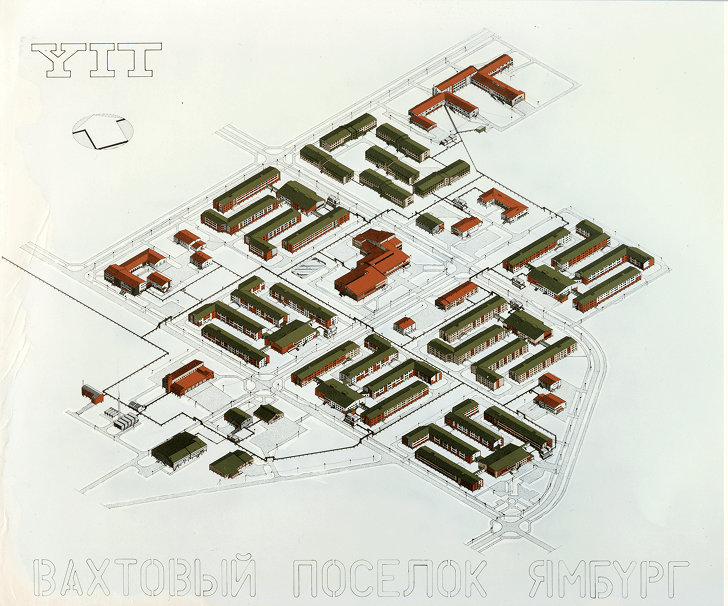
Preliminary findings reveal extensive trans-regional and international connections in the development of built environments for Western Siberian extractive industries. Major oil settlements such as Kogalymsky and Lyantorsky, along with key road infrastructure, were produced by organisations based in Soviet Estonia, Lithuania, and Latvia. The Yambourg gas settlement involved the Finland-based contractor YIT, and the widely used Unimo mobile housing model for shift workers was supplied by Czechoslovakia. Therefore, archival records relating to these projects can now be found in these successor states, which enables continued research despite the current inaccessibility of Russia-based archives.
Archival fieldwork began in spring 2025, with research conducted in Estonia, Latvia, Finland, and Canada.
1
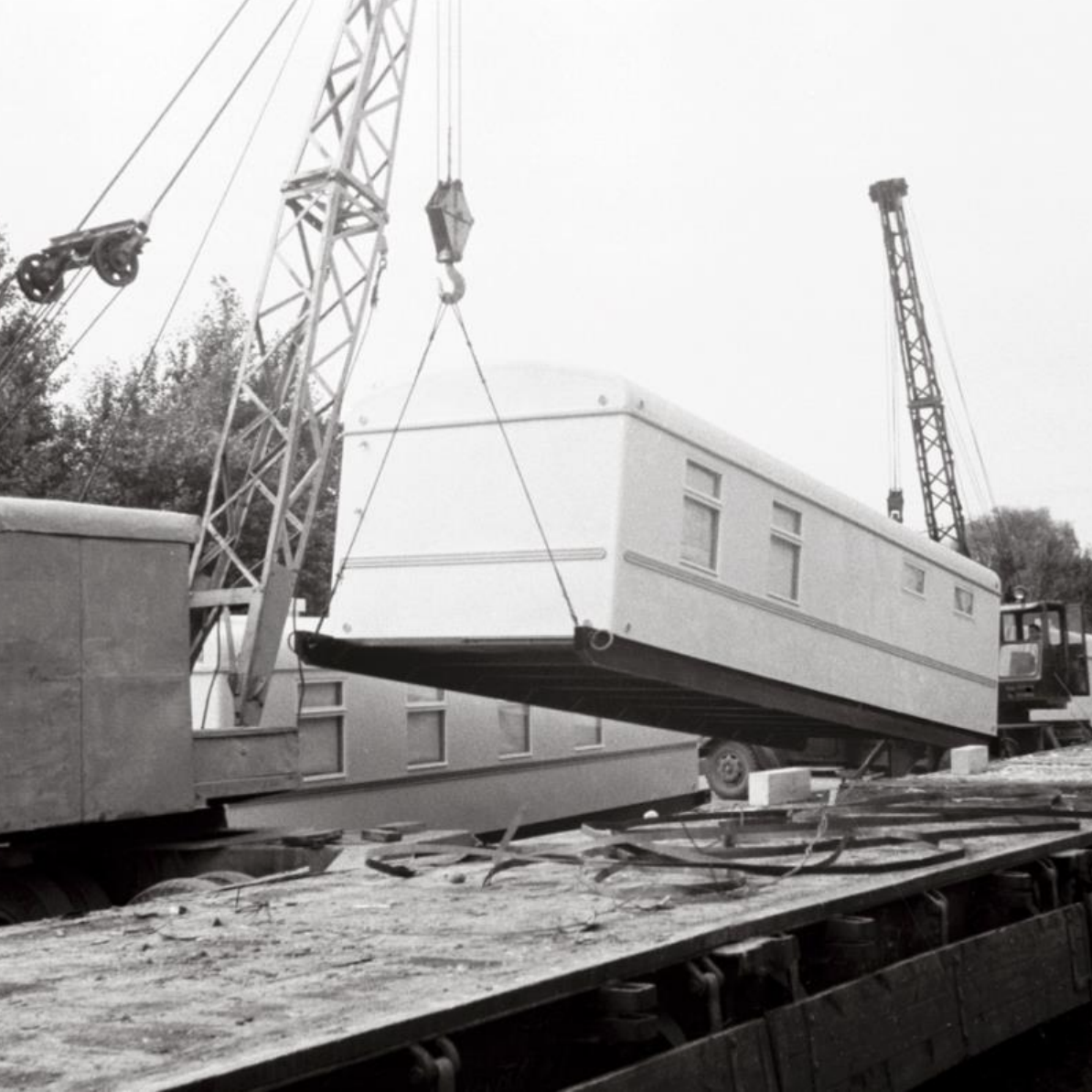
'Dispatch of mobile homes from the Tallinn Machine-Building Plant to the gas pipeline builders working on the new Tyumen oil and gas field.' Estonian Film Archives (EFA), EFA.250.0.46171.
2
'A drawing of the residential area of the fly-in-fly-out Jambourg gas settlement by YIT Oyj'. Central Archives for Finnish Business Records.
Research
Giproteatr at Work (PhD project)
x
Giproteatr at Work: Practices of Architecture at the Soviet Theatre Design Institute, 1953–1992 investigates institutionalised architectural practices and (paper)work routines at the Giproteatr Design and Research Institute of the Ministry of Culture of the USSR (Giproteatr) between 1953 and 1992. Combining approaches from institutional history, science and technology studies, and media theory, the project examines the dispersed documentary legacy of Giproteatr, which, based in Moscow, Leningrad, and Baku, designed cultural and performing arts buildings and stage-set equipment across the Soviet Union, as well as in the Lao People’s Democratic Republic and the Mongolian People’s Republic. Giproteatr also collaborated with international organisations such as the Council for Mutual Economic Assistance, the International Organisation of Scenographers, Theatre Architects and Technicians, and the Prague Quadrennial. Due to its privileged position within the Soviet architectural system and its specialisation in theatres (key public buildings in many socialist cities) Giproteatr offers a unique vantage point from which to examine the architectural profession’s engagement with the Soviet state and cultural policy.
Through archival and oral history research conducted in Russia, Germany, and the Czech Republic, the project reconstructs the evolving professional identities and technocratic strategies of Giproteatr architects within the context of late Soviet institution-building. It draws on a wide range of sources—reports, building norms, technical standards, journal publications, project documentation, and architectural competition entries—conceptualising them as forms of paperwork. The project argues that these documents formed the bureaucratic backbone of the Soviet architectural landscape and were central to architects’ technocratic influence in late Soviet urbanism, planning, and construction. These forms of paperwork were also crucial for organizing architectural practices, self-presentation, and negotiating the profession’s ambiguous status within the Soviet planned economy, increasingly defined as an applied scientific practice following Khrushchev’s reforms. Ultimately, the project challenges top-down narratives of the Soviet architectural profession, offering a more nuanced view of how architects navigated and informed state control, exemplified by standardisation and budget constraints, with individual creative ambitions. It contributes to broader historiographical debates on the history of the architectural profession, institutional history, and the role of experts and expertise in late Soviet governance.
Fieldwork for this project was conducted in 2019–2020; the PhD thesis was defended in 2023. A book manuscript is currently in preparation.
1
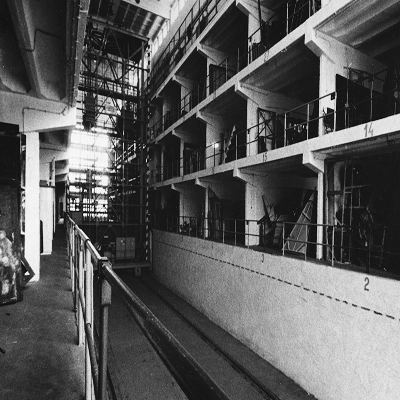
Excerpt from a foreign trip report submitted to the USSR Ministry of Culture by the Giproteatr Institute following a field trip to Czechoslovakia in 1979. The report highlights a mobile lift and technology for theatre decoration storage at the Bratislava Theatre and Scenery Combine’s warehouse. Source: Russian State Archive of Literature and Arts, f. 2329, op. 43, d. 258, pp. 27–30.
2
Terminological coordination. Title page and dictionary spread featuring the “spectators’ hall” and “multipurpose hall” entries. Source: COMECON Dictionary of Building Terms in 12 Languages.
3
‘A scheme of placement of theatres and cultural buildings built, under construction, reconstructed or under reconstruction by Giproteatr on the territory of the USSR’. Source: Stage Equipment and Technology, 1981.